Skip to content
Menu

THE OPEN NOTEBOOK

Ideas become
something useful.

Things I’m building. Lessons I’m still learning. A few thoughts on the world we could make.

Follow the conversation on LinkedIn ↗

Notes & ideas 13

A selection from LinkedIn · newest first

13 notes · original publication dates

01BUILDING & SHOPIFY

Your storefront was built for browsers. The next layer is for agents.

Meta's new shopping agent, Muse, had Shopify stores inside it on day one. That only helps if the agent can read your store. Here is the checklist we built around what kept breaking.

Read the noteClose the note

Meta launched Muse, an AI agent that shops on people's behalf, and Shopify stores were inside it from day one with no setup. That sounds like free distribution, but it only works if the agent can read your store. Muse never sees your photos, your theme or your brand story, and neither does ChatGPT. They read data.

Over the last six weeks, merchants kept showing our StoreSEO team how fragile that data is. One stray space made "in stock" invalid to Google. Product images went out as 115px thumbnails and failed Merchant Center. A review app's stray comma broke the entire product markup. Shipping and return policies were on the site but never reached Merchant Center. None of it is visible on the storefront, and all of it makes a product invisible to a machine. A large part of our last seven StoreSEO releases went into fixing exactly this.

The result is an agent-readable product checklist: availability that validates, full-size images rather than thumbnails, barcode (GTIN) and product condition, a Google product category, shipping and return policy in structured data, sale dates so agents can see the discount, and revenue tracking for traffic from ChatGPT and other AI assistants. Your storefront was built for people who browse. The next layer is for agents that decide.
Summary of my LinkedIn postOriginal post ↗
02BUILDING & AI

AR.bd is live. Made for people and their AI.

My new personal site is live at ar.bd. I built it with AI, and built it so AI agents can read it too: a project map, my notes, and an MCP endpoint.

Read the noteClose the note

Having my initials on a two-character .bd domain is part of the appeal, I admit. The bigger reason for the rebuild was another chance to work closely with AI. I used it throughout: design, code, content structure, SEO, testing and deployment. I stayed in the decisions, we went through revisions, checked the live results, and simplified whenever the design got more complicated than it needed to be.

The site brings together my companies, my writing and the AI projects I am working on. You can explore the project map, read my notes, or ask my AI about my work.

There is also a layer built for AI agents: structured public content and an MCP endpoint for finding projects, searching my writing and reading published notes. That felt right for a personal website at this point in my journey, a place people can explore, with information their AI tools can reach as well. masifrahman.com and asif.im now bring you to the same site.

Summary of my LinkedIn postOriginal post ↗
03BUILDING & AI

One scanner. Seven ways in.

AIScan has passed 3,400 scans, and most of them never came through the website. That shaped how I think about where a tool should live.

Read the noteClose the note

When AIScan crossed 3,400 scans, the number that interested me was not the total. It was where the scans came from. Most arrived through the API, the MCP server and the command line rather than the website. I had built one scanner and then kept adding ways to reach it, because the people who care about this problem do not all work in the same place.

Today there are seven ways in: the website, a CLI that runs with npx in about 20 seconds, an MCP server with 13 tools so Claude or Cursor can scan a site and act on the failing checks, a Telegram bot, a REST API, a Chrome extension and a Claude Code skill. The same engine sits behind all of them.

The reason this matters is that an AI agent reads a website nothing like a person does. It never sees the design or the hero image. It looks for a handful of small files, and most sites have never shipped a single one of them. That is how a good website ends up invisible to ChatGPT. The free scan stays free; I only charge for daily monitoring, because that is the part that costs money to run.

Summary of my LinkedIn postOriginal post ↗
04LEARNING & AI

Hundreds of problems. One tool at a time.

I started vibe coding in 2024. Hundreds of small tools later, the useful part is still solving a problem from my own work or life—and making the result available to others.

Read the noteClose the note

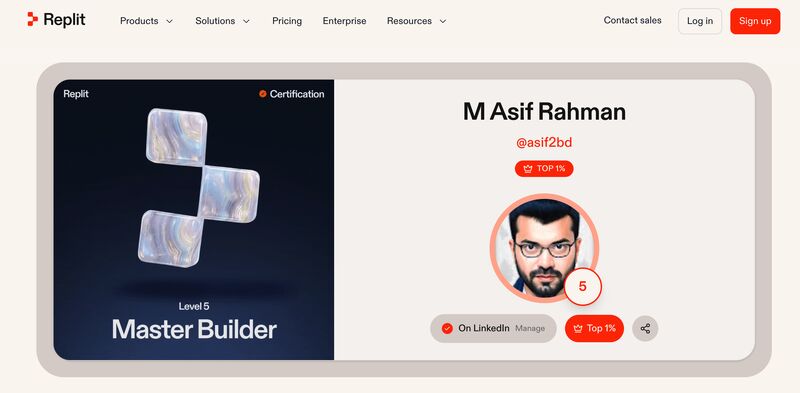
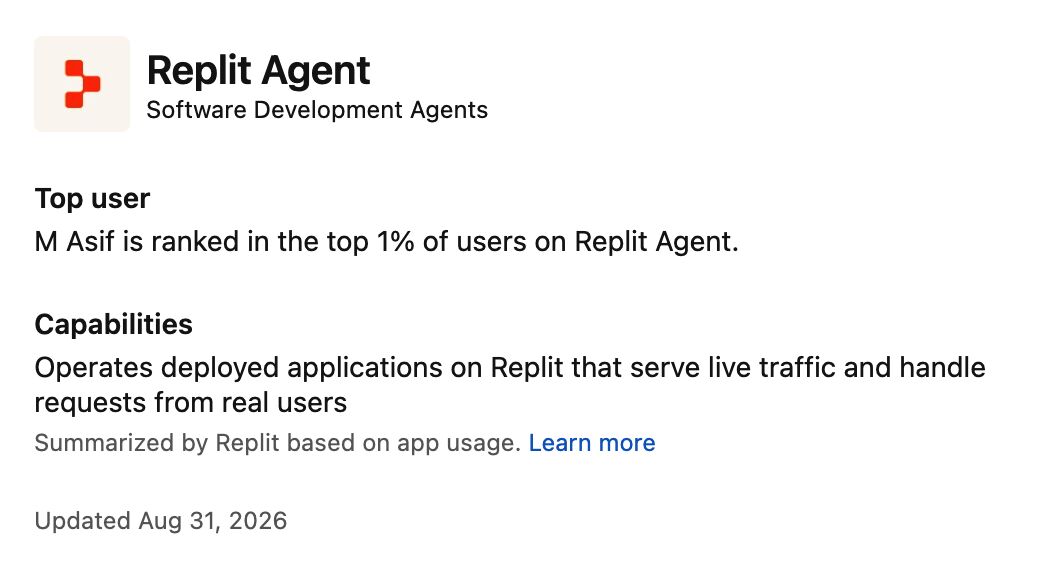
I noticed a Level 5 Master Builder badge on my Replit profile, placing me in the top 1% of Replit Agent users. The description focused on deployed applications serving real people. That was the part that mattered to me.

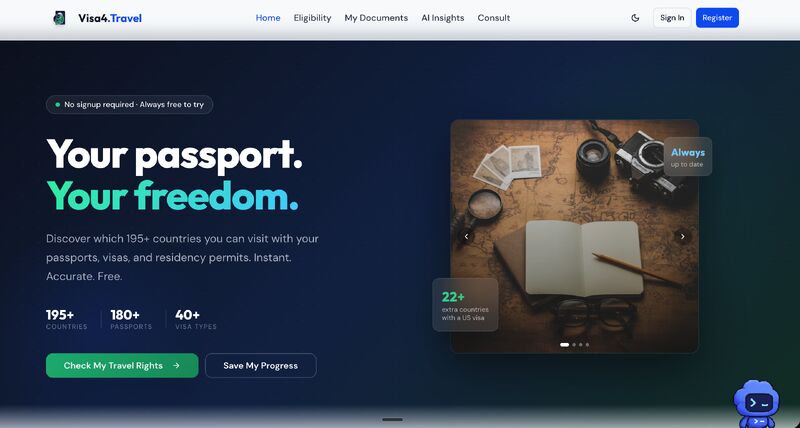
Across Replit, Claude Code and Lovable, I’ve built hundreds of small tools and apps. Most started with something in my own work or life that needed fixing. Visa4.Travel is one example: I wanted an easier way to check visa eligibility before a trip, so I built it and made it available to others.

I don’t build at that pace anymore, but many of those tools are still running. My advice is simple: take one problem of your own to AI and try making something useful.

M Asif Rahman’s Replit Level 5 Master Builder profile and top 1% badgeReplit Agent certification describing deployed applications serving real users; updated August 31, 2026Visa4.Travel homepage, a visa-eligibility tool built by M Asif Rahman
Summary of my LinkedIn postOriginal post ↗
05OPEN SOURCE & AI

A small missing piece. Now open to everyone.

I wanted to ask questions about my website analytics without opening another dashboard. That led me to build an MCP server for Umami.

Read the noteClose the note

The community tools I tried were built for an older Umami API. They could return plausible answers while pointing at the wrong data. That was a good reason to build something I could check myself.

I released the result as an open-source tool. It connects agents to Umami reports, keeps reads as the default, and makes writes an explicit choice. The useful part is being able to follow a question beyond the dashboard.

Summary of my LinkedIn postOriginal post ↗
06BUILDING & XCLOUD

Site health belongs in the hosting dashboard.

When a client finds a broken link before their agency does, a small technical problem becomes a trust problem. We built monitoring into xCloud to help catch it earlier.

Read the noteClose the note

The usual response was another plugin to install, scan and maintain. Our team wanted the hosting platform to handle more of that work, with the site, server and DNS already in view.

In this release, we brought broken-link scans, scheduled checks, redirects and exportable reports into the dashboard. It reflects a direction I care about: making everyday site maintenance simpler for the people responsible for it.

Summary of my LinkedIn postOriginal post ↗
07BANGLADESH & THE WORLD

Take Bangladesh into the world.

Going global starts with skills. I shared a practical playbook for Bangladeshis who want to build careers, businesses and communities across borders.

Read the noteClose the note

The ideas start with investing in a strong skill and choosing a market deliberately. A first job can become a starting point for building a business, a trading relationship or a community.

My central question is how success abroad can create more opportunity at home: connections between makers and buyers, stronger communities, and a wider horizon for the next generation.

English summary · original post in BanglaOriginal post ↗
08COMMUNITY & ENGINEERING

Good judgment still does the hard part.

Speaking to engineers at IUB, I heard a familiar worry: does learning to code still matter? My answer was that strong fundamentals become more valuable when building gets easier.

Read the noteClose the note

AI can help draft code, tests and documentation. The engineer still has to decide what is worth making, check whether the output is correct, and understand what happens when real users arrive.

A convincing demo is only a beginning. Product sense and engineering fundamentals help turn it into something people can rely on. I wanted the next generation of builders in Bangladesh to see that opportunity clearly.

Summary of my LinkedIn postOriginal post ↗
09COMMUNITY & AI

Clear thinking is a skill we can build.

At AI Summit Rajshahi, a student asked which skill matters most. My answer started with learning to explain a problem clearly.

Read the noteClose the note

Using AI is becoming part of everyday work. But two people with the same tools can produce very different results. The ability to structure a thought, describe a problem and explain what you want still matters.

I encouraged the students to develop a practical skill, use AI regularly, and keep practising writing and speaking. The summit was also a reminder of the talent and energy that exists beyond Dhaka.

Summary of my LinkedIn postOriginal post ↗
10BUILDING FOR BANGLADESH

What could better fuel distribution look like?

FuelBD started as a proof of concept: a way to make fuel quotas, subsidy calculations and the citizen experience easier to understand.

Read the noteClose the note

The demo brings together a citizen portal, a pump-station terminal and an administration view. I added Bangla and English, vehicle-verification flows, quota tracking and digital receipts as the idea developed.

It is an independent demonstration of what could be built, not an operating government service. The feedback is part of the work: it helps make the next version more useful.

Summary of my LinkedIn postOriginal post ↗
11BUILDING & AI

An office for a team of AI agents.

Running several AI agents creates a new problem: seeing what each one is doing. That was the starting point for MissionDeck.

Read the noteClose the note

I described agents handling different parts of a founder’s work, from research and analytics to drafting content. As the number of agents grows, keeping track of their tasks and costs becomes a job of its own.

We built MissionDeck around a shared task board, agent conversations, coordination and cost visibility. My suggestion was to start with one agent doing one useful thing, understand the work, and build from there.

Summary of my LinkedIn postOriginal post ↗
12BUILDING & SHOPIFY

A better workflow, with fewer tabs.

Our StoreSEO team brought Shopify Admin Intents into the app within a week. The useful change for merchants was being able to stay in the flow of their work.

Read the noteClose the note

With the StoreSEO 3.9.8 release, merchants could open product-editing screens within the app and act on SEO recommendations without repeatedly switching back to Shopify Admin.

We also added Loox review-schema integration and made improvements informed by Microsoft Clarity. I was proud of how quickly the team turned a platform capability into a more convenient everyday experience.

Summary of my LinkedIn postOriginal post ↗
13LEADERSHIP & LEARNING

Mentorship starts with better starting points.

People entering the workforce are learning through communities, videos and AI tools—and often building before anyone gives them permission. That changes how I think about mentorship.

Read the noteClose the note

In this reflection on different generations at work, I was especially interested in people who learn by making a first project: a store, a prototype or a small business.

For founders and leaders, guidance includes showing people where useful tools, resources and communities live. Onboarding should help them take that first practical step, as well as explain what the job requires.

Summary of my LinkedIn postOriginal post ↗